The Growth Trap: Why Your Manual Systems Will Break at 50 Orders a Day
What works at 5 orders a day becomes a nightmare at 50. Learn about "technical debt" in the warehouse, why barcode scanning is the single biggest accuracy upgrade you can make, and how the 60-second stress test reveals whether your operation is truly ready to scale.
It's 7 AM Monday. Your team walks into the warehouse. The weekend delivered more than 50 new orders — more than a full normal week from just two months ago. Nobody knows where to start. The pick list printed Friday night is already outdated; 12 more orders came in after midnight. And the one warehouse employee who knows where everything lives just called in sick.
This isn't a disaster scenario. This is the breaking point — the moment your operational systems, which worked fine at small scale, suddenly can't carry the weight you need them to.
The unsettling part: this point arrives earlier than most founders expect, and almost always in the middle of their best growth stretch.
The “Knowledge Lives in One Person” Problem
In small operations, there's usually one person who knows everything: SKU 0047 lives in the back-left corner of Bay B, Supplier X tends to ship short by 5%, and Client Y only accepts deliveries in the afternoon. That knowledge exists nowhere except inside that person's head.
At five orders a day, this is fine. At fifty orders a day — with 300 active SKUs, four warehouse staff who need to work in parallel, and a new hire starting next week — it's a single point of failure dressed up as operational knowledge.
Signs you're already there
- ✗ You've lost or delayed an order this month
- ✗ When a key employee calls in sick, the warehouse visibly slows down
- ✗ You can't confidently answer “do we have it in stock?” in real time
- ✗ Month-end stock reconciliation takes one to two full days
- ✗ You've shipped the wrong item because two SKUs looked similar on the shelf
The solution isn't to find a better employee. The solution is to move that knowledge out of someone's head and into the system. Labeled bin locations (A-01-3, B-12-2). Standardized pick sequences. A single searchable product catalog that anyone — including a first-day hire — can navigate without a guide.
The Math of Mistakes: A 2% Error Rate Sounds Small Until You Run the Numbers
At five orders a day, a 2% pick error rate means one wrong shipment roughly every ten days. Embarrassing, but manageable — an apology, a replacement, and you move on.
At fifty orders a day with that same 2% rate: one angry customer every single day. Not every week. Every day. Multiply that by return shipping costs, re-delivery expense, customer service time, and brand damage — and suddenly a “small” error rate is eating real margin.
Manual warehouses don't make more mistakes because they hire worse people. They make more mistakes because of the sheer number of visual decisions required per shift: reading a label, matching a SKU code, verifying a bin location, confirming a quantity. Each step is a chance to slip. When your volume is ten times higher, so is your opportunity for error.
Barcode Scanning: Not Intimidating Hardware — The Single Biggest Accuracy Upgrade You Can Make
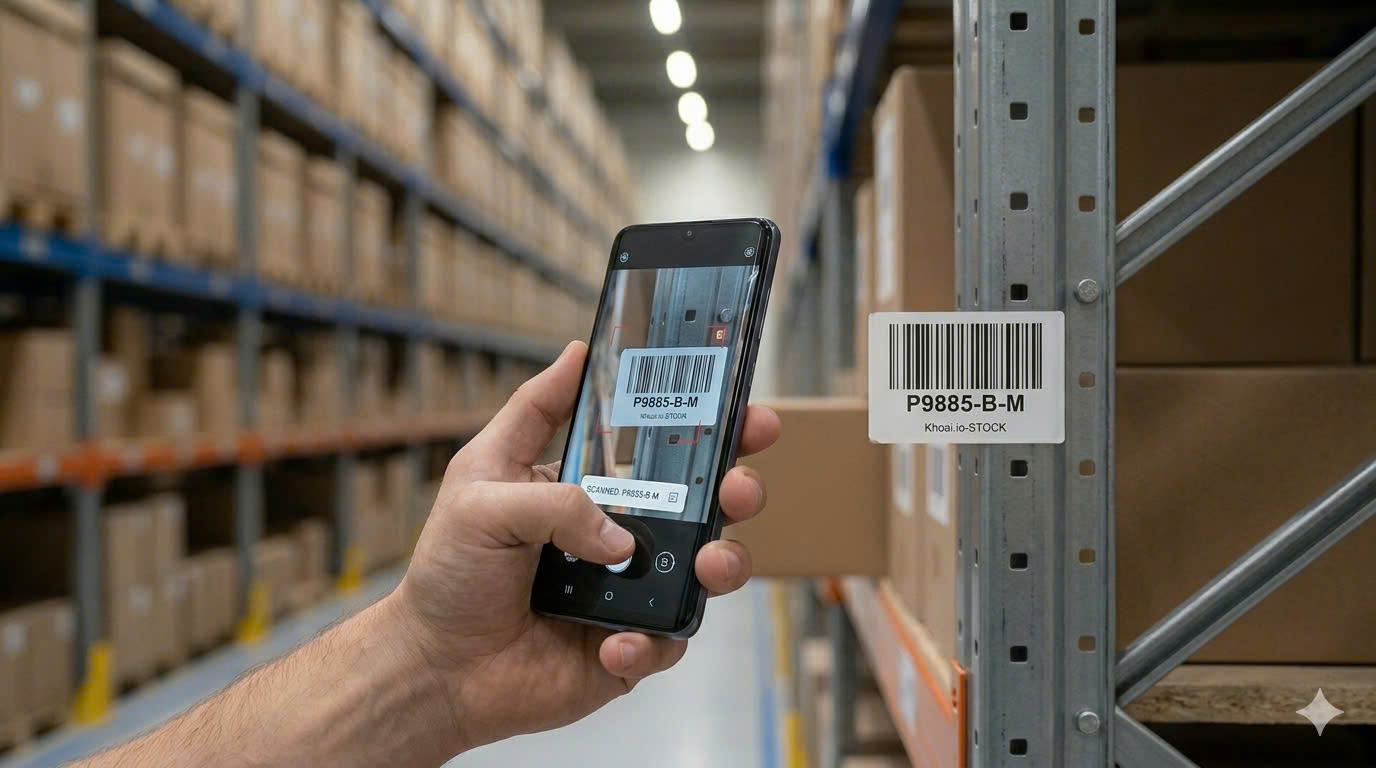
Most small warehouse owners assume barcode scanning means expensive dedicated scanners, complex setup, and an IT project. It doesn't. Khoai works with any smartphone camera — no additional hardware required.
The accuracy gap between “reading a label by eye” and “scanning a barcode” sounds incremental. It is not:
- Reading by eye: human error rates of 1–3%, compounding under fatigue and time pressure
- Barcode scan: error rates below 0.01% — functionally zero
When you scan, the system confirms instantly: correct product, correct quantity, correct bin. There's no room for “I thought it was...” or “they look the same.” The software catches mistakes before the order leaves your building.
The “Messy Middle”: Too Big for a Spreadsheet, Feels Too Small for “Real” Software
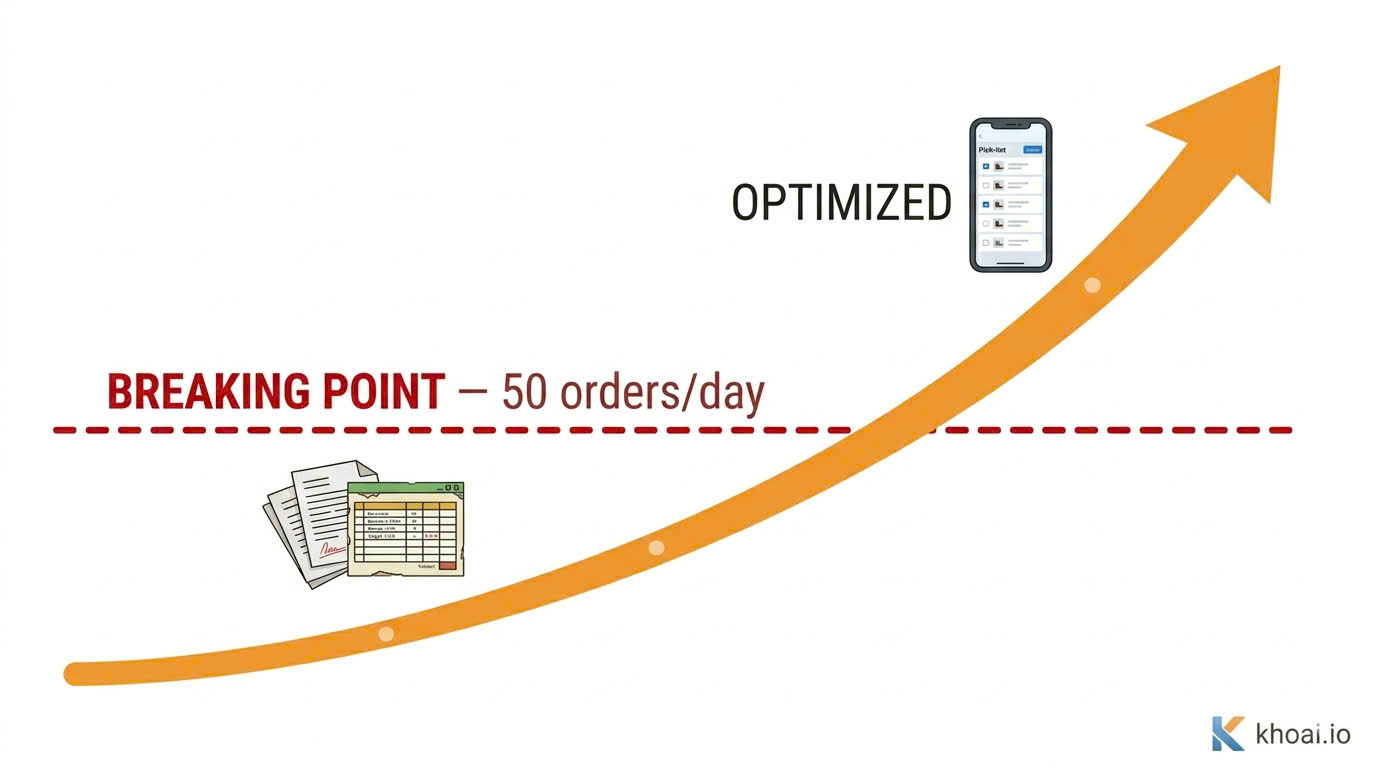
This is the hardest phase: you're processing 30–60 orders a day, spreadsheets are starting to cause headaches, but you still feel like you're not quite big enough to justify a “proper” system. Enterprise WMS platforms feel designed for Amazon-scale operations, not for you.
This is exactly where most growing businesses get stuck. They wait until the pain is bad enough to force action — but by then, they 've already lost customers, burned out their best staff, and accumulated months of messy data that needs cleaning up before the new system can even start.
Khoai was built specifically for this phase. Not a bloated enterprise WMS with hundreds of features you don't need. Not a spreadsheet that will snap under pressure. Khoai is operational in hours, requires no implementation consultant, and scales with you from 30 to 300 orders a day without a system change. You bring your team — Khoai brings the structure.
The 60-Second Stress Test
Here's the simplest way to know whether your warehouse operation is genuinely ready to scale:
The challenge: could a stranger — someone who has never set foot in your warehouse — locate a specific SKU in under 60 seconds?
If the answer is “no” or “only if [name] is here” — you're running a person-dependent business, not a process-dependent one. That distinction will cost you when growth accelerates.
If your system passes — bin locations are clearly labeled, the product catalog is searchable, any team member can pick from a list — you're building something that can scale. If it doesn't, you're building a trap for your future self.
Software Doesn't Just Automate — It Forces You to Build Processes
One of the least-discussed benefits of moving to a warehouse management platform is that it forces you to make decisions you 've been deferring. When you enter a product into the system, you have to decide: what is the SKU? Where does it live? What's the unit of measure? What's the reorder threshold?
Those decisions — once recorded in the system — become your standard operating procedures. Not a document someone wrote and nobody reads. Living procedures, enforced every time anyone scans a barcode or confirms a pick.
That's how you make the shift from a person-dependent business to a process-dependent one. And only once you've made that shift are you genuinely ready to grow.
Stuck in the messy middle? Here's your way out.
Khoai gives you labeled bin locations, barcode scanning on any phone, and the structure to handle 300 orders a day with the team you have right now. Start free — no credit card, no consultant required.
Try Khoai free →